
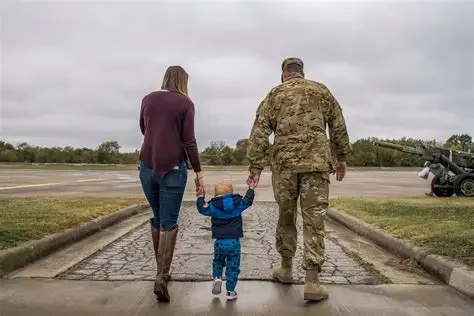
Military parents face unique challenges that impact both family stability and mission readiness. This legislative approach offers greater flexibility in deployment cycles, emergency support for families during long separations, and innovative solutions to expand the caregiving workforce.
It recognizes that the burdens of service don’t end at the base—and neither should our support. By modernizing military family policy, we invest in stronger families and a stronger force.
MILITARY PARENT’S
REPRIEVE PLAN
-
Construct a Standardized Rotation Model for Parents in Active-Duty Service
”Family structure is force readiness”- Applies to all branches of service, parents choose 3-, 6-, or 9- month deployment rotations
- Prioritizes mental health by reducing prolonged separation from children
- Rotation schedules are locked in 60+ days before deployment to aid planning
- Attempt to standardize dwell time and non-combat tour lengths across all services -
Establish specialized visa programs for vetted au pairs and nannies to assist military families during deployment or long-term absence.
”Secure Families Strengthen America”- Immigrant Care Associates serve military families as nannies or cleaning aides
- Applicants vetted through DHS, State Department, and DOD Background systems.
- Pathway to expedited green card and eventual citizenship after 4 years of certified service, allowing for improved workplace retention, reduced labor costs for DOD, and better military readiness -
Create flexible funding and access points for families impacted by long-term deployments
”Care continuity matters when you’re on the front lines”- For deployment longer than 6 months, grant immediate first month benefits
- Monthly flex funds of $400-750 / month depending on deployment status and family size
- Eligible uses are licensed childcare, tutoring, parenting classes, household support
- Care coach check-ins offered in-person or remotely to help manage transitions, mental health, and family logistics -
Extends dependent health coverage through age 26 for military and veteran families.
Continue eligible military-family health coverage through age 26 without requiring separate young-adult premiums.
Remove school enrollment and financial-dependency requirements before age 26.
Prevent employment or access to an employer plan from automatically ending family coverage.
-
Ensures military and veteran children are not penalized for beginning work or becoming financially independent.
Prevent employment alone from terminating benefits earned through a parent’s military service.
Replace abrupt income-based benefit cliffs with gradual phaseouts where financial eligibility is required.
Protect part-time jobs, internships, apprenticeships, and early-career employment from unnecessary benefit penalties.
-
Reduce instances of unnecessary family separation surrounding childbirth, adoption, and military-directed moves.
Establish protected stabilization periods after birth, adoption, or placement of a child.
Limit unnecessary PCS moves and extended separations during protected family periods.
Provide additional protections for single-parent and dual-military households.
-
Protects children from unnecessary educational and medical disruption when military service moves their families.
Guarantee rapid school-record, special-education, and accommodation transfers during a PCS.
Maintain continuity of medical, therapeutic, and disability-related services during relocations.
Provide transition protections for children when a military parent separates or retires from service.
-
Ensures military families can understand school quality and maintain continuity of learning when military orders move their children between U.S., military-operated, and overseas schools.
Require clear public reporting on academic outcomes, graduation rates, accreditation, student supports, and available special-education services at schools serving military children.
Create standardized transfer records that communicate completed coursework, academic progress, IEP/504 accommodations, intervention needs, and other essential learning information before a military family moves.
Require receiving schools to review transferred records promptly and provide comparable placement, services, and academic credit so military children are not forced to repeat learning or lose needed supports because of a PCS move.